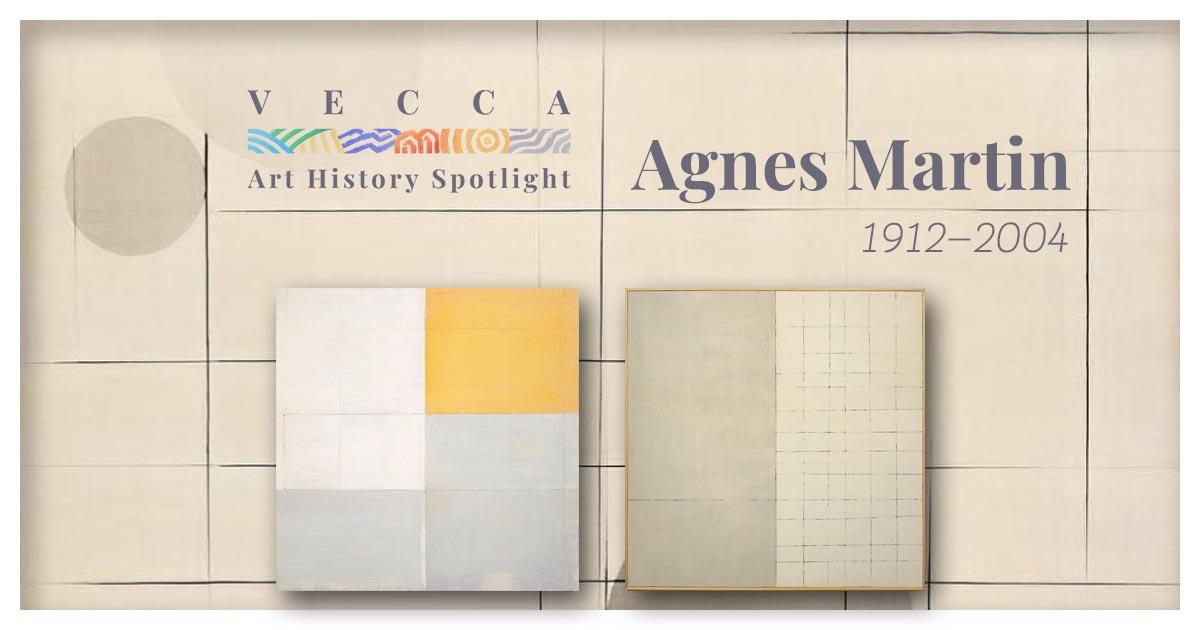
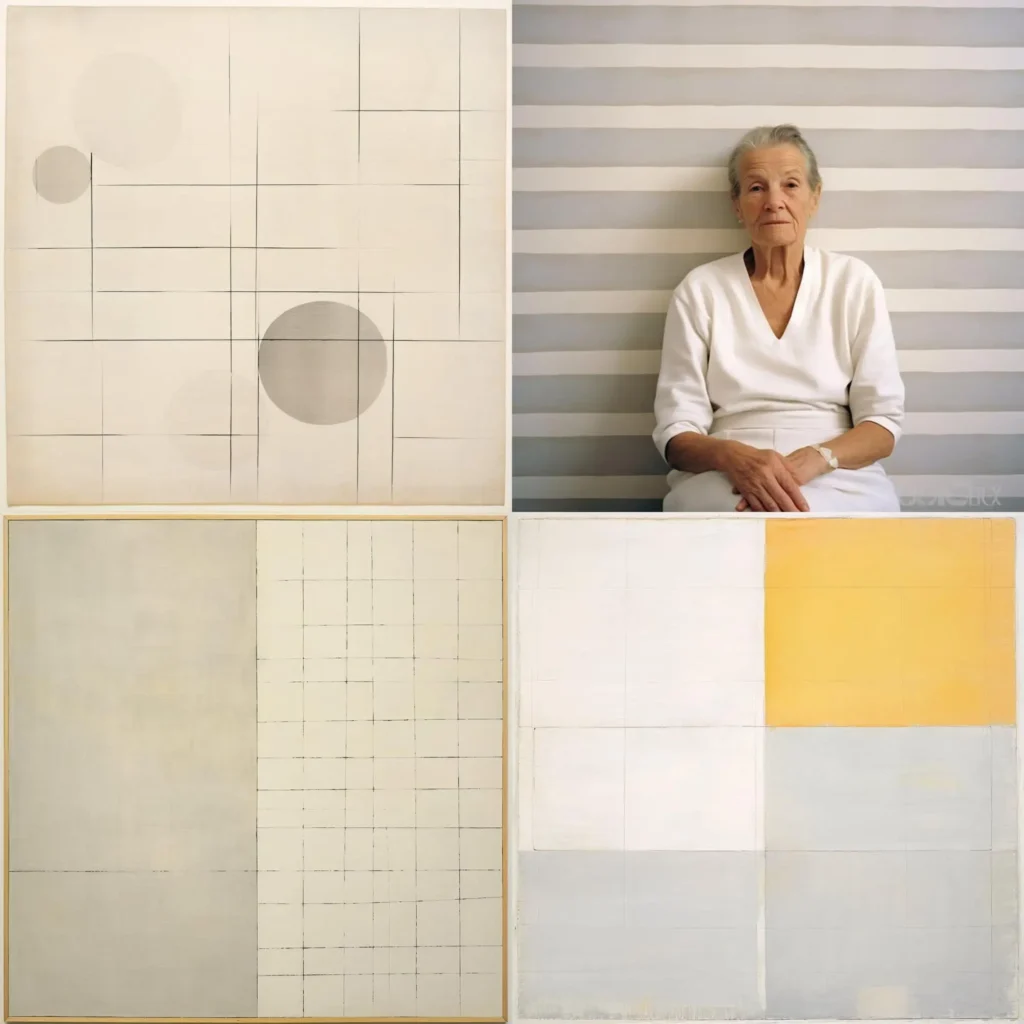
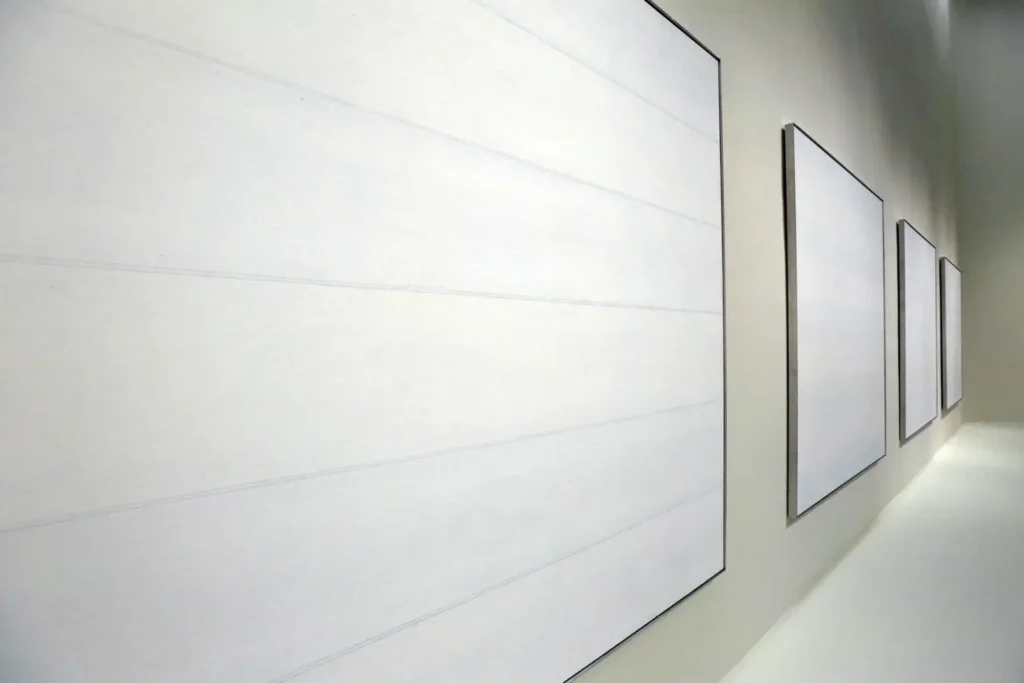
Agnes Martin’s philosophy on life underpins her work as an artist: the essence of beauty, the importance of happiness, and the significance of inner awareness. She says art is the concrete expression of our most subtle feelings.
Martin was born in 1912 in Saskatchewan, Canada, grew up in Vancouver, and moved to the United States in 1931. She studied at Western Washington University, School of Education, prior to moving to NYC to attend Columbia University. While living in New York, she was exposed to and became interested in modern art and took studio classes at Columbia’s Teachers College. At Columbia, she also heard lectures by the Zen Buddhist scholar, D.T. Suzuki, and became interested in Asian thought and Zen practice as a way of life.
In 1947, she went to Taos, NM, received another degree from University of New Mexico in Albuquerque, then returned to Columbia University for her M.A. in modern art. In New York, she lived in a loft in Coenties Slip in lower Manhattan, home to other artists and their studios, including Ellsworth Kelly, James Rosenquist, Leonore Tawaney and Robert Indiana. An avant-garde and liberal community at the time—this was the late 60s–it is said that Martin often used a feminist lens when critiquing other artists’ works.
Martin was also a schizophrenic, although her illness went undocumented until 1962. It’s reported that at one point she opted for electric shock therapy for treatment, but the full effect of the mental illness on her life was unknown.
In 1967, she left the art world of New York, eventually settling in Cuba, New Mexico. She rented a 50-acre property, built herself an adobe home and lived a simple life during which she did not paint.
In 1971, the curator Douglas Crimp, visited her with interest in organizing her first solo non-commercial exhibition. After that, Martin began writing and lecturing at different universities about her work. Her interest in painting was reignited. She approached Pace Gallery, and the gallery’s founder became her lifelong dealer.
Eventually, Martin bought property and moved to Galisteo, NM, where she again built her own adobe home. She lived a simple life in solitude until 1993, although she was more active in the art world, traveling, showing and lecturing. In 1993, she moved to a retirement home in Taos, NM, until her death in 2004. (Source: Wikipedia)