What better way to kick off July than to highlight Jasper Johns, the 2011 Medal of Freedom recipient. America may know him best for his paintings and reliefs of Old Glory—red, white, and blue American Flags and flags embedded within flags. His imagery also includes maps of the United States, targets, numbers and letters.
Johns (1930 – present) is an American painter, sculptor, printmaker and draftsman. Johns’ work cuts across three art movements: abstract expressionism, neo-dada, and pop art. Artists working in these genres were questioning (and furthering) the definition of art.
Johns was born in Georgia, reared in South Carolina and eventually moved to New York to study at the Parsons School of Design until he was drafted during the Korean War. In 1953, he returned to New York where he met and was influenced by (and romantically involved with) Robert Rauschenberg (1925-2008). Rauschenberg, whose work also stretched over a long career, pioneered Neo-Dadaism. He was most noted for very large mixed-media works that combined painting, sculpture and found objects. (Source: Wikipedia) Rauschenberg used everything that wasn’t nailed down in his large-scale works: cardboard, newspaper, industrial objects., etc. Later, he developed silk-screen collages and graphic paintings that used photographic images from magazines and newspapers, then layered them with broad expressive abstract brushwork (Source: Britannica). These works were the forerunner to the Pop Art movement.
Why are Johns and Rauschenberg so significant in the history of art? Because these works were a major departure from oil/canvas paintings, opening up new horizons and concepts in the practice and process of artmaking.
Jasper Johns, like Rauschenbberg, influenced nearly every artistic movement from the 1950s to present. By using found objects like beer and coffee cans, Johns obliterated the difference between fine arts and mass culture, opening the way for Pop Art of the 60s and Conceptual Art and Performance Art in the 1960s and 1970s. Performance Art? Yes. Johns has had a long association with Merce Cunningham’s Dance Company. He also cofounded, along with John Cage (Cunningham’s partner), the Foundation for Contemporary Performance Art.
Johns’ fame began in earnest when Leo Castelli, New York gallery owner and influencer, was visiting Rauschenberg’s studio and asked to visit Johns’, one floor below. Castelli offered Johns a solo show right on the spot. The founder of New York’s Museum of Modern Art (MOMA) bought three paintings. These were the first works by Johns to be included in a museum collection. (Ref.: Bernstein, Roberta (2016). Jasper Johns Catalogue Raisonne of Painting and Sculpture, Vol., 5. Wildenstein Plattner Institute. p. 31.)
In 1954, Johns destroyed all previous artwork that he still owned and began the paintings for which he is best known: depictions of flags, maps, targets, letters, and numbers. (Nan Rosenthal, 2004.) There have been many opinions and critiques regarding Johns’ use of commercial and easily identified images ranging from they spare him the problem of composition to their familiarity allowed him to explore perception, ambiguity and symbolism and the relationship between life and art.
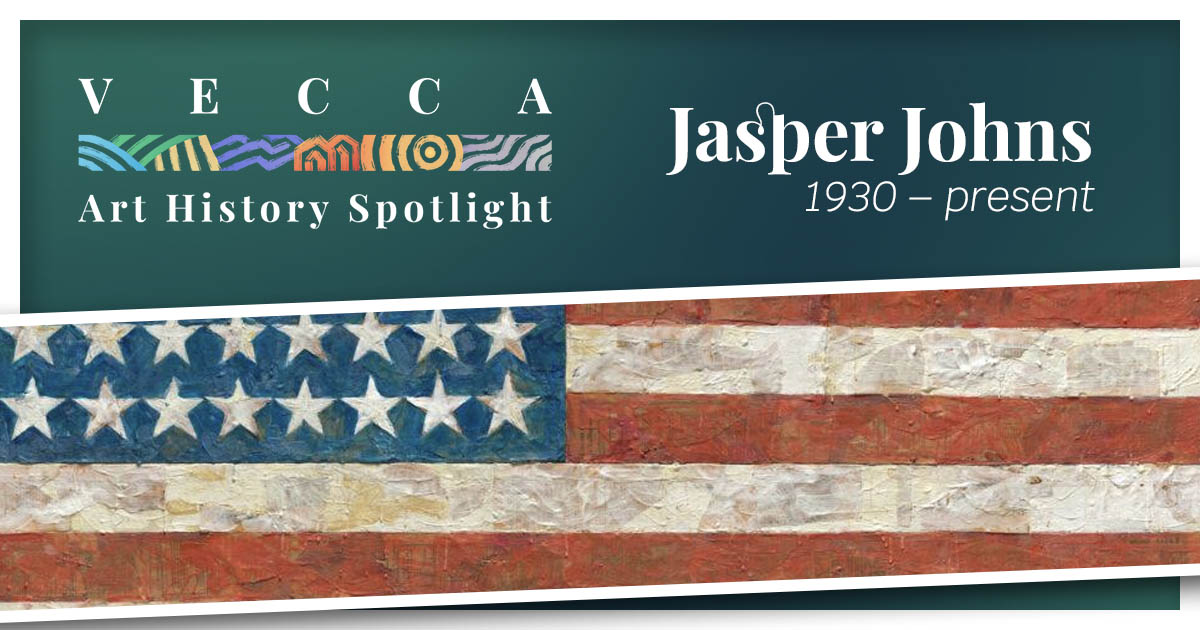
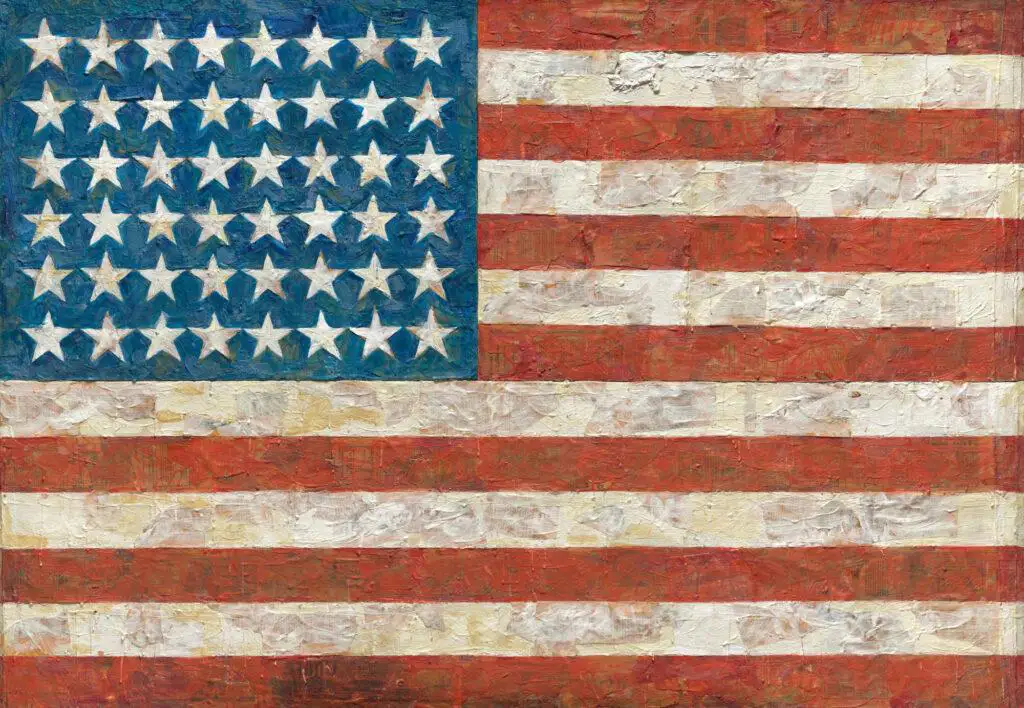
His early encaustic painting Flag (1954–55), painted after having a dream about the American flag, marked the beginning of a new period for him. He painted it when he was 24, two years after returning from military service. The painting is 42.2 inches by 60.6 inches. It is made using encaustic, oil paint, and newsprint collage on three separate canvases, mounted on a plywood board. It resides at the Metropolitan Museum of Art in New York.
There are many notable things about Johns’ work. He painted images of two-dimensional objects that were easily recognized. His work extended across both abstraction and realism. He explored the boundaries between art and objects. Through his deft handling of materials, he raised these everyday objects to paradigms or icons. Because the iconic subjects became almost cliché and lacked the emotions of abstract expressionism, he moved modernist 20th century American art to postmodern thought and practice.